
10 Top-Notch Processing Services Providing Quality Management System and ISO Certification in Singapore
Owning a successful business and being held in high regard means consistently investing time, energy, and resources into your operations. To maintain quality of product or service, businesses remain vigilant by taking proactive measures whenever necessary.
One essential step many organisations take to ensure success is pursuing certification opportunities that can give them a competitive edge. A notable certification certainly bolsters an company's portfolio and offers a range of advantages as outlined below in this article. Most notable are ISO, bizSAFE, HACCP, and Halal certifications.
As a company, gaining certifications in any of the three domains—corporate, professional-based or product-specific—is essential for improving public image. This article discusses two specific ISO certifications as well as bizSAFE, HACCP, and Halal certification processes.
Check our recommended ISO certification consultants in Singapore for more information on how to prepare for audits and compliance.


How to Pick an Approved Service Provider for ISO Certification and Secure Observance of International Standards
Obtaining certification shows that your business values tangible excellence, staying on top of industry and international standards, and continuous learning. These benefits raise your professional standing within your industry, existing clients, and new business chances or projects bidding. It is an effective way to showcase how seriously committed you are in delivering prime-level service or world-class products.
Certifications, such as ISO, bizSAFE, HACCP and Halal, can help any business streamline their productivity, procure resources faster and expand across the globe. This increased efficiency will open unprecedented opportunities for innovation and growth that cannot be passed up—it is a surefire way to create competitive advantage in the market and boost your company's standing.
How ISO Certification Helps Your Business
The International Organization for Standardization (ISO) is a non-governmental organisation that produces standards to ensure the quality, safety and efficiency of products, services and systems. ISO sets standards to advance organisations' management systems and their manufacturing processes and services; however they do not offer certifications nor conformity assessments—these are carried out by third-party certification bodies.
Obtaining an ISO certification is a marker of success for any organisation, indicating that they have followed international standards developed to create exceptional products and services. This certification will act as an impetus for an effective management system that meets all requirements laid out in the standard. By complying with these regulations, you can excel within your industry through higher sales, customer loyalty and profound satisfaction.
An ISO-certified business enjoys the following benefits:
Promotes Best Practices
Unlocking access to globally acknowledged finest practices across your organisation is made possible through ISO and other standards. Standards are available for a wide range of topics from information security management system, risk management, and food safety to health and safety and quality management principles. With these in place you can achieve great success with the assurance that all operations meet global expectations.
Increases Productivity
Creating and maintaining a successful business demands that you define, document, and observe your operations. Additionally, it is vital to set objectives for the organisation and assess how well they are being met. These steps combined form the foundations of an efficient and productive enterprise.
Prioritises Customer Satisfaction
Maintaining customer satisfaction is a cornerstone of success for any business, and standards can help you achieve this goal. Quality control procedures, complaint management systems, and client feedback monitoring are all aided by certification programmes. In fact research has shown that one of the most substantial benefits from such accreditation is fewer complaints from customers. Adopting quality-assurance standards guarantees that your patrons remain happy.
Improves Revenues
Certification can be beneficial to your bottom line. A 2015 analysis of 92 studies displayed that three out of five companies which adopted ISO experienced an increase in revenues, and this number was significantly higher than for non-certified companies. The greatest performance results are observed when businesses make a consistent effort to enhance operations, not just before the next recertification audit—investing both time and energy is essential.
Opens New Markets
Utilising standards in your business can open doors to new markets and expand opportunities. For instance, if you abide by certain standards, you may pursue government contracts or even join a larger company’s supply chain for megaprojects. Moreover, many international customers recognise these global standards as a marker of credibility—giving them confidence when considering doing business with you.
Fosters Team Commitment
ISO standards can help you cultivate a more engaged and productive workforce. Research suggests that certified businesses experience higher levels of job satisfaction, reduced turnover rates and absenteeism, improved employee motivation, and increased communication between managers and employees. The certification process encourages meaningful collaboration between managers and the work force to establish shared objectives for the business; this joint effort leads to greater dedication in improving operations quality across all areas of your company.
Obtaining certifications offer many advantages to businesses of all sizes, even those with a limited number of personnel. Smaller companies sometimes strive for recognition to meet the demands of their supply chain or when they wish to adhere to optimal processes behind the scenes. The ISO 13485, ISO 9001, bizSAFE, HACCP, and Halal certifications are discussed below.
ISO 13485 Certification
If you are a manufacturer, supplier, or dealer of medical devices and equipment, this quality management systems (QMS) certification is the ideal choice for you. It is designed to help your business reach its full potential in terms of quality standards.
ISO 13485 is the definitive medical device standard, guaranteeing that all products adhere to regulatory requirements and customer expectations. This certification provides a reliable guarantee of safety for professionals and customers alike in healthcare facilities around the world.
ISO 13485:2016 is specifically formulated to meet the needs of medical device manufacturers and suppliers, underpinned by its process model approach based on that of ISO 9001. This standard has been developed with one clear goal in mind—to create a harmonised regulatory framework for medical devices worldwide. Through this equipment-centric system, there are specific demands placed on the production, installation, and servicing procedures for any related product or service, such as:
- Validation of processes
- Implementation of a QMS with several enhancements
- Risk management approach to product development and product realisation
- Compliance with statutory and regulatory requirements
- Effective product traceability and recall systems
By adhering to the ISO 13485 standard, companies can lower safety and legal risks while creating a more cost-effective work environment. Additionally, its international reputation as an assurance of quality and security in medical device manufacturing allows firms with certification to be trusted and reputable providers. To ensure relevance in today's market environment, it is reviewed every five years; revisions are made accordingly so that they meet current industry needs.
ISO 9001 Certification
ISO 9001:2015 certification is widely-acknowledged as the premier QMS and followed by organisations around the globe. This certification guarantees reliability and consistency of products or services, making it suitable for companies in almost every sector—from manufacturing to banking institutions, educational establishments, healthcare units, governmental bodies, retail stores and more.
ISO 9001 is an international standard that demonstrates a company's obligation to provide quality services and products which adhere to customer and regulatory requirements. It is the most sought-after of all standards from the ISO 9000 series, as it can be certified by any organisation striving for excellence in their industry. With its use, organisations are able to exhibit consistent consistency with regards to meeting needs set forth by customers or government regulations.
The ISO 9001 standard is founded upon the plan-do-check-act methodology, providing organisations with a process oriented approach to documenting and assessing their structure, responsibilities and processes. In addition, this standard contains detailed guidance on topics, such as:
- Requirements for a QMS (documented information, planning and determining process interactions)
- Responsibilities of management
- Management of resources
- Product realisation (design to delivery)
- Measurement, analysis, and improvement of the QMS (internal audits and corrective and preventive action)
To guarantee that ISO 9001 continues to stay up-to-date with the continuously evolving business environment, changes have been made in version 2015. A few of the central alterations featured in ISO 9001 are as follows:
- The introduction of new terminology
- Restructuring some of the information
- An emphasis on risk-based thinking to enhance the application of the process approach
- Improved applicability for services
- Increased leadership requirements
BizSAFE Certification
BizSAFE is a nationally-recognised programme created to help companies develop their safety and health capabilities in the workplace. This innovative initiative encourages businesses in Singapore of all sizes to make sound investments in creating healthy work environments that promote wellbeing for everyone.
To reach the highest level of safety management system and health standards, bizSAFE is an essential five-step programme that will guide your company to a better working environment. The initial step is for top management to fully commit in promoting Workplace Safety and Health (WSH) regulations.
Level 1
The company's top management completes a three-hour workshop for CEOs/management. This course can be done conveniently and quickly online. Upon successful completion of said course, the organisation receives a Certificate of Attendance.

Level 2
Your organisation selects a Risk Management (RM) champion to take part in the two-day level 2 course on Develop and Implement a Risk Management Plan. This training will provide an understanding of the fundamentals of RM and relevant legal requirements under WSH (RM) Regulations. Upon satisfactory completion, participants will be awarded a Statement of Attainment.
Level 3
Adhering to the WSH Act is mandatory for all workplaces, which means that risk assessments must be conducted for any activity or process being carried out. This is key to comply with WSHA regulations and other associated legislations—bizSAFE Level 3 status can only be achieved if a Ministry of Manpower (MOM)-approved WSH auditor evaluates your organisation's implementation of RM. Meeting the bizSAFE level 3 certificate standard is necessary for any business deals and contracts with government agencies, main construction firms, or other bizSAFE partners.
Level 4
If your business wishes to achieve the bizSAFE Level 4 status, assign a WHS Management System (WSHMS) programme lead who will attend the four-day course on WSHMS. After completing this plan, then your company can apply for bizSAFE Level 4.
STAR
To earn bizSAFE STAR status, your business requires an SS506 Certification from a Singapore Accreditation Council-accredited certification body or BS OHSAS 18001 or equivalent certification alongside an RM Implementation Audit Report from a MOM-approved WSH auditor. These safety consultants can guide you through the process of implementing workplace safety and health management systems before working with third-party certifying agencies to examine and certify these systems.
HACCP Certification
Establishing Hazard Analysis Critical Control Points (HACCP) is an internationally respected approach to recognising and controlling potential food safety risks. When integrated into a comprehensive food safety programme, it can give customers, the public, and regulatory entities the confidence that your business has taken steps towards safeguarding their health through a well-managed system.
Implementing the HACCP system is essential to ensure food safety in every step of production and distribution, from obtaining raw materials all the way through to consumption. It has become a major requirement for many global producers and vendors as they strive towards Global Food Security Index audit schemes compliance. Not only does it guarantee high-quality standards throughout the supply chain, but also provides an effective approach for any organisation looking to keep their food safe.
To receive HACCP certification in Singapore, businesses adhere to the Seven Principles of HACCP:
- Conduct a hazard analysis
- Identify critical control points (CCP)
- Establish critical limits for each CCP
- Establish monitoring procedures for each CCP
- Establish corrective actions for each CCP
- Establish verification procedures
- Establish record-keeping and documentation procedures
To ensure that a food safety programme is effective, more than just HACCP is considered; pre-requisite programmes, such as pest control, traceability and recall, hygiene, and sanitation are developed and implemented. Furthermore, to guarantee the quality of suppliers' products and services, it is essential to develop ingredient specifications and create a vendor assurance system.
Singapore-based organisations that create, process, or package food products are encouraged to attain HACCP certification. This includes:
- Food processors
- Restaurants and food service establishments
- Manufacturers of frozen, canned, and dehydrated foods
- Retailers that sell packaged food products
- Farmers or other agricultural producers
- Food transportation companies
Halal Certification
To ensure inclusivity and accommodate the needs of all Singaporean citizens, food businesses must be aware of the religious requirements for food preparation. In particular, when serving Muslim clients, establishments are required to provide dishes prepared according to "Halal" principles.
The Arabic word "Halal" translates to lawful or permissible, thus Muslims must only consume food and drink that is Halal. Anything considered Haram (forbidden), such as the meat of animals already dead prior to being slaughtered are forbidden from consumption.
Being Halal-certified means much more than abstaining from pork and lard in food preparation. All ingredients, utensils, and animals are slaughtered according to Islamic law. Moreover, individuals are guaranteed that the raw fixings utilised in cooking are Halal; for instance gelatin may contain components from Haram animals including bones or skin.
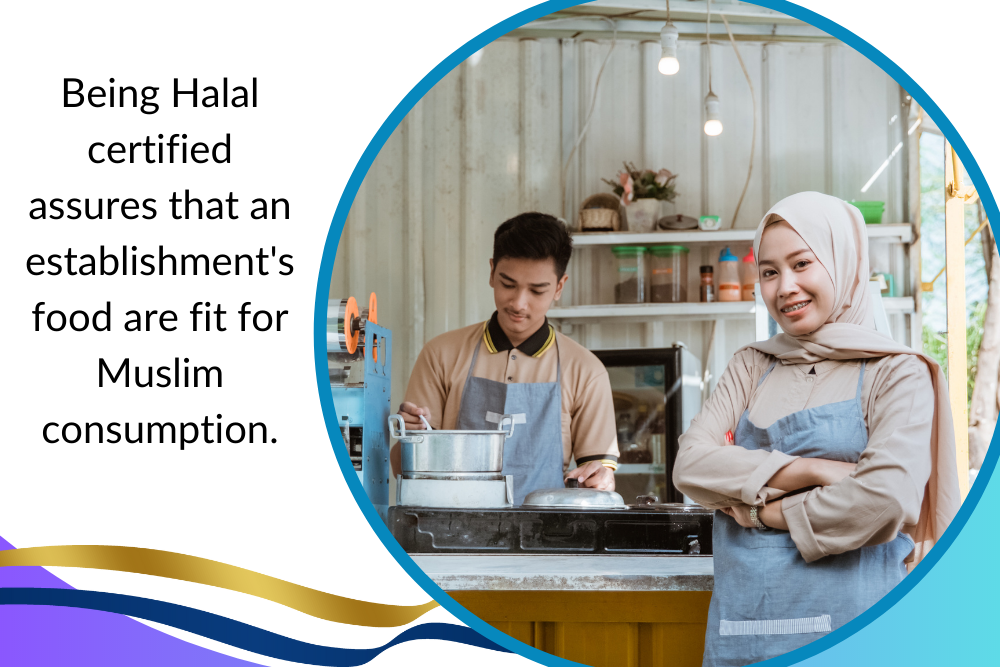
In order for a restaurant to be Halal-certified, it is essential that the correct procedures are followed in food preparation. For instance, any utensils that may have come into contact with Haram ingredients first undergo ritual cleansing by Majlis Ugama Islam Singapura (MUIS) or an agent appointed by MUIS before being used in Halal cooking. This way you can ensure that your guests enjoy their meals without worrying about contamination from non-Halal sources.
For attaining Halal certification, three essential conditions are fulfilled:
- All raw materials used adhere to the Halal standards and possess appropriate documentation in support
- A minimum of two Muslim staff are employed at each premises applied for
- Application of all ten principles listed within Singapore MUIS's Halal QMS
To apply for Halal certification, you can submit your application online through the GoBusiness licensing platform. As part of the submission process, make sure to include:
- Establishment’s name and address
- Menu, ingredients, suppliers, premise layout plan, and other related information
- Application and certification fees
The application is thoroughly checked and authenticated to validate that you have fulfilled the Halal Certification Conditions. A certification audit will be conducted by an auditor visiting the premises to assess compliance with the 10 principles.
How to Look for an ISO Registrar or Accredited Certification Body
When searching for an ISO registrar, it is important to ensure that they meets certain standards and criteria. The ISO has established specific requirements for organisations seeking certification from them. Businesses need to consider the following:
Accreditation
The ISO Registrar in Singapore must be accredited by a National Accreditation Body (NAB). The Singapore Accreditation Council serves as Singapore’s NAB and is responsible for accrediting organisations that meet the specific standards set by the ISO. They should have accreditation certificates issued by either the Singapore Quality Accreditation Council or the Singapore Accreditation Council. This is to ensure that the registrar follows ISO standards and provides quality services.
Reputation
Be sure to ask for references or contact clients who have already been through the process of certification with that registrar. Additionally, read through the terms and conditions for using their services to understand exactly what kind of service they provide and how long the process will take.
Specialisation
In addition, check if the registrar has any professional qualifications related to the service they provide. Examples of such qualifications include certified ISO auditor or internal auditor and lead auditor certifications. It is also important to find out what type of ISO certification the registrar offers and its scope and duration. Different types of ISO certifications have different requirements and timelines, so it is essential to make sure the registrar can provide the right service for your needs.
Integrated Audit or Gap Analysis
It is also important to find out if the registrar offers an integrated audit or not. An integrated audit combines different elements of ISO certification, such as compliance, quality management, environmental management, and safety and health are included in a single audit process. This is beneficial as it makes the certification process more efficient and cost-effective as it enables the registrar to get a more complete picture of your organisation’s performance.
Corporate certifications are evidence of quality products or services. Oftentimes, these certifications come from third-party organisations that are acknowledged nationally and internationally. Businesses use certificates to make their brand more attractive and procure more partnerships.
If you need help preparing for an ISO certification, check out our top-rated ISO certification consultants and firms to know how.
Latest Becozon Offer
Boost your business with these exclusive deals by our esteemed Becozon partners

Here's How Companies Adopt
Hybrid Work Post-COVID
Looking for a CRM software?
Get customisable, cloud-based sales and operations CRM software suitable for any industry. Contact us for a demo today!
Contact Us